
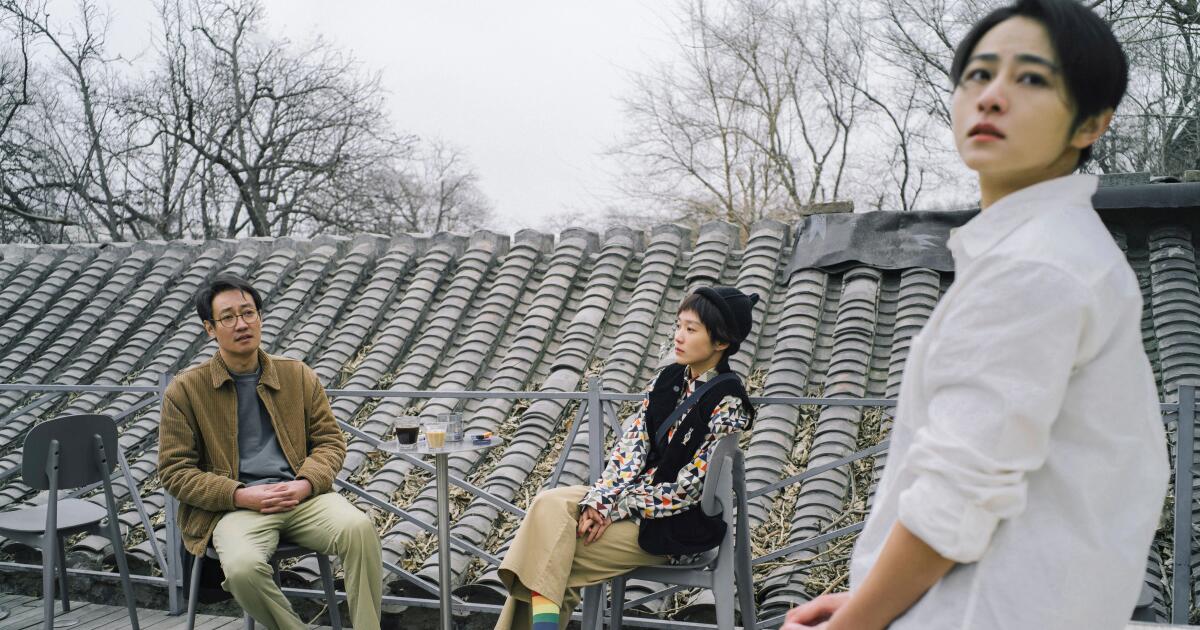
Zhang Lu, a Chinese director, brings to the screen a contemporary drama “The Shadowless Tower” that subtly reveals its characters through a series of understated interactions and moments. Zhang’s approach is to slowly unveil the insightful aspects of the characters, specifically focusing on a middle-aged man from Beijing who is grappling with his past and uncertain future.
The film centers around Gu Wentong (played by Xin Baiqing), a divorced ex-poet turned restaurant reviewer who has a charming 6-year-old daughter named Smiley. Smiley stays with Gu’s sister and her husband, the details of this living arrangement are not explicitly explained. The bond between Smiley and her father is evident and the separation from Gu’s wife was not bitter but rather due to an overwhelming sense of formal politeness that extinguished their passion.
Gu, a melancholic chain-smoker dealing with the recent demise of his mother, seems to be struggling to take care of himself let alone others. Gu’s neighborhood in Beijing is distinguished by the renowned 13th-century Buddhist temple, the ‘Shadowless Tower’. The tower, visible from afar, is known to never cast a shadow. Contrastingly, Gu seems to be living in perpetual shadow.
Gu’s hesitance to reciprocate to the overtly flirtatious gestures of his younger and lively colleague, photographer Ouyang (played by Huang Yao), raises questions. They seem to have a connection: engaging conversations, shared walks, and the relaxed atmosphere a few drinks bring. Perhaps, the idea of romance with a vivacious individual is too overwhelming for a reserved person like Gu. Adding to his worries, he recently discovered that his estranged father, who was ousted by his mother during his childhood, resides close by in the coastal town of his early years.
Gu’s exploration of this newfound connection, in which Ouyang becomes involved due to her own emotional history, shapes the narrative of “The Shadowless Tower”. The film beautifully captures the journey of life moving forward while reminiscing the past, portraying emotions without slipping into sentimentality. It leaves viewers contemplating the complexity of human nature without providing clear answers. Zhang, with the assistance of Piao Songri’s subtle cinematography, allows viewers to experience the emotional resonance of each moment. The film communicates the silent struggle of bridging a gap created by separation.
“The Shadowless Tower” is filled with a profound silence which reminds viewers of the variation of this trait across different filmmakers. While silence in an Ingmar Bergman movie felt ominous and heavy, Chantal Akerman used it like a vulnerable room tone. Zhang utilizes silence to depict a sense of active tranquility. Thus, when a distinct sound disrupts the quietness – be it the sound of water, music from a videotape, or a child’s inquiry – it resonates like the melody of life, the elements that ignite us.
Zhang intermittently incorporates a far-off humming sound similar to that heard in science fiction movies signaling an incoming UFO. Is it a remark on the everyday peculiarity of life? Possibly. Or it could be a device to keep us alert to the rhythms of our surroundings, our personal ‘Shadowless Towers’, which might seem mundane and constant but save us from the darkness of life.
Similar posts:
- Shocking Revelation: Gena Rowlands in Full Dementia, Son Nick Cassavetes Confirms Alzheimer’s!
- Shocking: Inmates Reunite with Kids for One Night in ‘Daughters’ – A Tear-Jerker Review!
- Shocking Truth Unveiled in ‘Rob Peace’ Story of Race and Fate – Is It All It Seems?
- What’s Behind Netflix’s Iconic ‘TUDUM’ Sound? Shocking Truth Revealed!
- Charlie Hunnam as Ed Gein: Shocking First Look at Netflix’s New Monster!

My name is Alex Carter, a journalist with a deep passion for independent cinema, alternative music, and contemporary art. A University of California, Berkeley journalism graduate, I’ve honed my expertise through film reviews, artist profiles, and features on emerging cultural trends. My goal is to uncover unique stories, shine a light on underrepresented talents, and explore the impact of art on our society. Follow me on SuperBoxOffice.com for insightful analysis and captivating discoveries from the entertainment world.