
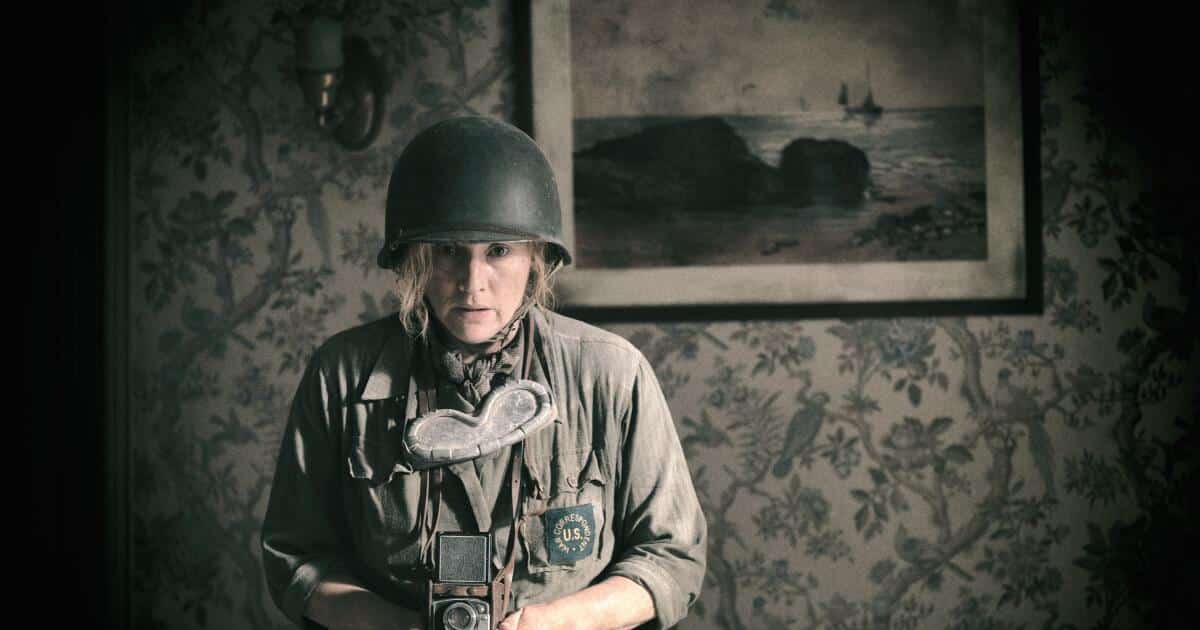
The burning inquiry in a movie about a war reporter is often “Why?” Why are they dedicated to this profession? Why do they persist, dig and risk their lives amid the anguish of war? This is the focal question in the new biographical film “Lee,” based on the celebrated photographer Lee Miller, who documented some of the most unforgettable scenes of the Holocaust as a journalist for Vogue during the Second World War. The inquiry is brought up by a young man (Josh O’Connor), who in 1977, interviews a somewhat irritable Miller (Kate Winslet) about her life and profession at her English home, attempting to elicit deeper responses than her usual curt remarks.
This narrative outline encompasses just one extraordinary episode of the vibrant and unconventional life of Miller, who experienced so much both before and after the war. A former American model and creative photographer, she was once the inspiration and lover of Man Ray, and had taught photography in New York City. When we reconnect with her in the late 1930s, she’s carefreely exploring the south of France with her friends, all of them oblivious to the impending horrors that would come with the rise of Adolf Hitler. In a few short years, Miller will discover her passion and purpose, as well as traumas that nearly shatter her.
“Lee,” in which Winslet stars and also produced, has been a nine-year endeavor. The project was developed in collaboration with Antony Penrose, Miller’s son and the author of “The Lives of Lee Miller,” which was adapted by scriptwriters Liz Hannah, Marion Hume, and John Collee (Lem Dobbs also has a “story by” credit). The script follows a conventional biopic layout, with a twist that reflects Penrose’s experience writing about his mother’s life and trying to decode it.
The film marks the narrative feature directing debut for Ellen Kuras, an acclaimed cinematographer, television director, and Oscar-nominated documentarian. Kuras and Winslet have been acquainted since Kuras filmed “Eternal Sunshine of the Spotless Mind,” and her career as a cinematographer fits perfectly with the subject of the female perspective in wartime. Miller focuses on women in war, not just because she’s often excluded from male-dominated areas, but because she feels a strong pull to do so, and it eventually becomes one of her artistic and journalistic fixations.
While Miller is frequently mentioned in relation to her well-known love affairs (Winslet has a beautiful, sensual chemistry with Alexander Skarsgard, who portrays her husband, Roland Penrose), a significant portion of “Lee” is dedicated to her work dynamics and close friendships. Marion Cotillard and Noemi Merlant play Lee’s French confidantes, Andrea Riseborough co-stars as Audrey Withers, Lee’s editor and advocate at Vogue, while Andy Samberg, in his first solely dramatic role, plays Davy Scherman, a friendly New York photographer who becomes Lee’s professional ally as they report from war zones in France and Germany.
Samberg’s performance is a surprising delight here, offering a nuanced yet incredibly touching performance. Winslet’s brave and formidable Lee, an irresistible force, has her own fears and insecurities, and she finds comfort in Davy, a rare man whom she trusts. As France is liberated in 1944, they hear of missing individuals and they journey deep into Germany at the war’s conclusion to reveal the gruesome reality of the Holocaust, relentlessly forging ahead in their quest for truth.
“Lee” is grounded by an extraordinary, prolonged sequence as Lee and Davy document the devastation and human catastrophe of Hitler’s rule: Nazi suicide pacts, piles of bodies, concentration camps, prisoners, and victims. The sequence gradually leads to the capturing of an iconic photo of Lee bathing in Hitler’s bathtub, one of her most renowned images. In the context of the film, it makes complete sense: after seeing the human cost of Hitler’s murderous reign, it seems fitting to belittle or dominate him in this uniquely feminine way. In the film, Lee is both the subject and the creator of this image and its creation is cathartic, leading to an emotional breakdown for Davy, subtly portrayed by Samberg. The resilient Lee remains composed, expressing herself through her work, and numbing her emotions with alcohol and pills.
Winslet delivers an impressive performance as always, embodying Lee’s blunt, straightforward demeanor, a tough exterior under which a deep wound continues to bleed. It finally erupts in a remarkable confession, shedding light on every preceding action. This is a deeply insightful biopic, and while it may follow a familiar structure, the groundbreaking woman at its core was anything but conventional.
Katie Walsh is a film critic for the Tribune News Service.
Similar posts:
- Unsung Holocaust Hero’s Shocking Story Revealed in ‘One Life’ – You Won’t Believe It!
- Shocking Holocaust Story ‘White Bird’ Reveals Unexpected Kindness: You Won’t Believe It!
- Oscar-Winner Jonathan Glazer Ignites Firestorm with Controversial Israel Remarks!
- Shocking! ‘Bad Boys’ Star Theresa Randle Arrested for Alleged Felony Assault by LAPD!
- Shocking Secrets of the Shadowless Tower Unveiled – How a Mysterious Past Blocks Connection!

My name is Alex Carter, a journalist with a deep passion for independent cinema, alternative music, and contemporary art. A University of California, Berkeley journalism graduate, I’ve honed my expertise through film reviews, artist profiles, and features on emerging cultural trends. My goal is to uncover unique stories, shine a light on underrepresented talents, and explore the impact of art on our society. Follow me on SuperBoxOffice.com for insightful analysis and captivating discoveries from the entertainment world.