
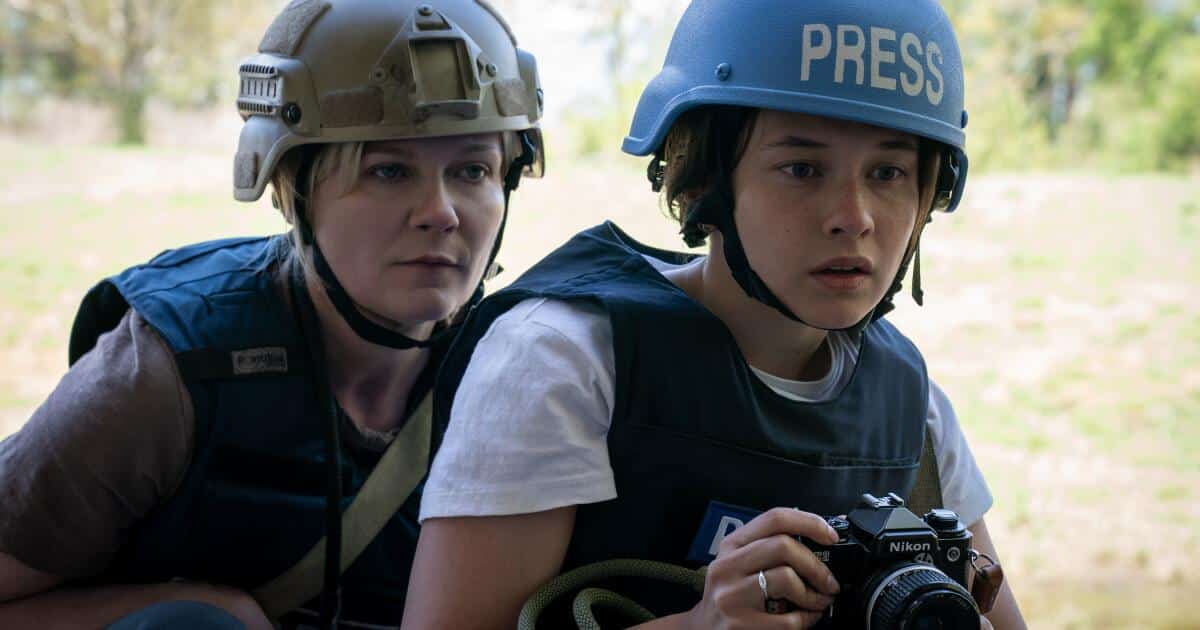
With positive reviews and a successful box office debut, Alex Garland’s engaging “Civil War” is already set to become one of the year’s most discussed films. The director’s vivid, often chilling portrayal of a war-ravaged America and a government in turmoil has incited considerable dialogue among audiences and critics.
Despite the story’s fictional “what if” premise, “Civil War” is nonetheless imbued with a harsh realism that is integral to its impact.
The main thrust of “Civil War” is centered on war-fatigued photographer Lee (Kirsten Dunst) and her writer partner Joel (Wagner Moura), who enlist an ambitious young photographer named Jessie (Cailee Spaeny) and a seasoned journalist named Sammy (Stephen McKinley Henderson) as they embark on a perilous journey to the White House, which is under attack by advancing rebel forces.
Carolyn Cole, a long-time national and international news correspondent for The Times since 1994, watched “Civil War” last week and agreed to respond to questions about the film’s portrayal of journalists working in hazardous environments. Cole’s work documenting the impact of the civil war in Liberia won her the 2004 Pulitzer Prize for feature photography. Moreover, she is a two-time recipient of the Robert Capa Gold Medal for war photography from the Overseas Press Club of America. The following is a lightly edited version of her responses.
As a seasoned photojournalist, how would you assess the accuracy of “Civil War”?
While the concept of an ongoing civil war is unsettling, I found many elements in the movie, like the interactions between an experienced and a rookie photographer, and the group of journalists traveling together, to be believable. Although the situations they encountered were extreme, they were conceivable. Real-life images come to mind, such as the American civilian contractors hanging from a bridge in Fallujah, Iraq, or the U.S. soldier being dragged through the streets of Mogadishu, Somalia. I’ve captured images of riots, gunfights, mass graves, and the aftermath of deadly bombings. Though every movie tends to magnify the intensity of each scene, the depicted scenarios are feasible.
Were there any instances in the film that you felt grossly misrepresented the experiences of photojournalists working in a conflict zone? How so?
I felt that Dunst did a commendable job portraying a seasoned photojournalist, particularly with her composed demeanor throughout most of the film. However, there were several scenes where she was carrying a camera bag but didn’t have her camera out. There were instances when she was using a short lens when a telephoto lens would have been more appropriate and vice versa. Also, there were moments when significant events were unfolding and she wasn’t taking any pictures. Toward the end of the movie, she ceases working entirely, succumbing to PTSD. But compared to many movies I’ve seen where photographers are depicted as paparazzi with a flash attached to the top of the camera, I felt the overall representation of the photographers was commendable.
In one scene, Jessie is seen developing her film on location. While some photographers still use film, a darkroom is required to load the film into the developing cans. In the past, I would carry all the chemicals with me on assignments and develop the film in a bathroom, then dry it with a hairdryer.
The concluding scenes are clearly exaggerated, but Lee stepping into the line of fire to protect Jessie seemed more like a maternal instinct than a professional one. By that point, the passing of the baton to Jessie is full-blown. The physical and psychological toll of being a conflict photographer, as well as the impact it has on one’s personal life, do accumulate over time.
Were there any moments in the film that felt especially true to life?
There’s a scene where Lee and the reporter are arguing over who will accompany them on the trip. That’s a common occurrence. Journalists often pair up in vehicles due to cost, limited fuel, or safety considerations. And there have been many instances where I’ve had to sleep in the car, especially while covering several hurricanes. There’s a scene where all the cars have been abandoned on the freeway. I observed something similar while covering Hurricane Katrina in New Orleans. It’s astonishing how quickly societal norms disintegrate in a crisis. It only takes a day or two before looting begins and people start driving in the wrong direction on the freeway.
We first see Lee at a protest in New York that quickly escalates. How does her behavior during that scene and others like it compare to your experience?
In their initial meeting, Lee educates Jessie about safety, hands her a bright yellow vest, and shields her during an explosion. While photojournalists don’t typically wear construction vests, it was a thoughtful gesture. It would be nice to think that anyone would step in to protect a colleague in such a situation, but I’m not entirely convinced.
There are repeated instances in the film where journalists are harmed or face potential harm. How realistic are these dangers, and what did you think of their colleagues’ reactions in those scenes?
The risks of covering conflicts are real. My photographer friend Chris Hondros and Tim Hetherington were both killed in Libya during the Arab Spring; Anja Niedringhaus, an Associated Press female photojournalist, was killed in a targeted attack in Afghanistan; and I saw a colleague grazed in the head by a bullet in Haiti, to name a few. Over 78 journalists were killed in 2023, according to the Committee to Protect Journalists. The bond among reporters and photographers can be incredibly strong. Many of the photojournalists working in the field are people I’ve known for years. It’s a kind of brotherhood. We depend on each other, even if we work for rival organizations. You would expect colleagues to help each other in crisis situations. Life-threatening situations can reveal a person’s true character. I’ve witnessed both positive and negative outcomes.
What are your thoughts on Dunst’s portrayal of Lee as someone progressively tormented by the horrors she has photographed?
Each person is affected differently by what they have witnessed. I’ve never experienced flashbacks, nightmares, or PTSD, but I know others who have. Not only does it affect you professionally, but it can also be challenging to maintain relationships in your personal life. Dunst’s portrayal of Lee seemed realistic in that the years of documenting trauma had finally caught up with her. Most likely, those flashbacks would occur not during the heat of battle but during quieter moments of reflection. After covering each conflict, I would immediately return to covering local news. It helped me move on and not dwell on what I had experienced. I channeled all my energy into documenting each crisis to the best of my ability, knowing that was my role.
Lee’s philosophy is that her job is merely to record events and let others interpret the significance of her images. Do you have a guiding principle in your work?
My mission has always been to serve as the eyes for those who cannot witness events in person. That was my goal while covering the Iraqi people from Baghdad as the U.S. began bombing the city in 2003, and in Afghanistan following the events of Sept. 11. I view photographs as proof, a record of what occurred and the impact on those involved. Having a clear purpose gives me the confidence to approach strangers, who seem to understand that I’m there to do a job. Photography is a universal language that most everyone understands. It used to be that most people at home and abroad understood the role of journalists, but sadly, we have now become targets ourselves.
In the film, Lee and her colleagues often enter volatile situations quickly, without fully gauging what might be happening or the risks they may face. They appear to trust their instincts more than the unreliable information available to them. What does the real-life process entail for knowing where to go and under what circumstances?
It involves gathering as much information as possible about any given situation. A road that is safe one day could be too dangerous the next. That’s why journalists are always asking questions. It requires drive and determination to reach the front line. Ultimately, it’s about risk-taking. Each person has their own risk tolerance. It’s crucial to travel with people you know and trust, and who you can depend on. What needs to be documented is often something or somewhere that officials don’t want you to see. Instinct is something you can develop over time, but it isn’t infallible. I always advise young photographers to spend a few years working in the U.S. and in places like Mexico, Central America, and the Caribbean before venturing out to cover stories farther afield. Given the current state of affairs in our country, we could be at the epicenter of the action in the near future.
In some scenes, Lee is seen wearing a helmet or protective gear. In most scenes, particularly during the climactic battle in Washington, she is not. Is that realistic?
There were several aspects about the ending that were not realistic. I doubt that soldiers would have allowed journalists to be so close to the action, even assisting them. Regarding protective gear, some journalists choose not to wear vests and helmets because they believe it gives them a false sense of security or restricts their movement. I always wear such gear in conflict situations, but I’ve also been fortunate enough to have never been injured. Plenty of soldiers have been killed despite wearing their protective gear.
After the gruesome incident with the militant soldiers, Jessie, the budding photographer, tells Lee that she has never been more afraid in her life but that she has never felt more alive. Can you relate to that sentiment?
I wouldn’t put it in those terms. Undoubtedly, surviving any life-threatening event is going to be unforgettable. Your adrenaline is surging and you are completely focused. It’s common to hear civilians who have lived through war reflect on that being the most significant time in their lives. That said, it’s not something anyone would desire. When you’re covering a conflict, there’s nothing normal about it. Some people may be drawn to the profession for the adrenaline rush, much like some engage in dangerous sports. What is most meaningful for me is knowing that I am bearing witness to history and striving to create images that do justice to the people and events I’m documenting.
Similar posts:
- Unbelievable Luck Behind the Most Shocking ‘Civil War’ Scene You Won’t Believe!
- “Civil War” Movie Betrays Characters & Fans! Shocking Political Compromises Revealed!
- Civil War Movie Takes America By Storm, Smashes Box Office Records!
- Justin Chang Scoops Pulitzer Prize! Unbelievable Achievement for LA Times Critic!
- Everything You MUST Know About A24’s Insane Dystopian Action Movie ‘Civil War’!

My name is Alex Carter, a journalist with a deep passion for independent cinema, alternative music, and contemporary art. A University of California, Berkeley journalism graduate, I’ve honed my expertise through film reviews, artist profiles, and features on emerging cultural trends. My goal is to uncover unique stories, shine a light on underrepresented talents, and explore the impact of art on our society. Follow me on SuperBoxOffice.com for insightful analysis and captivating discoveries from the entertainment world.