
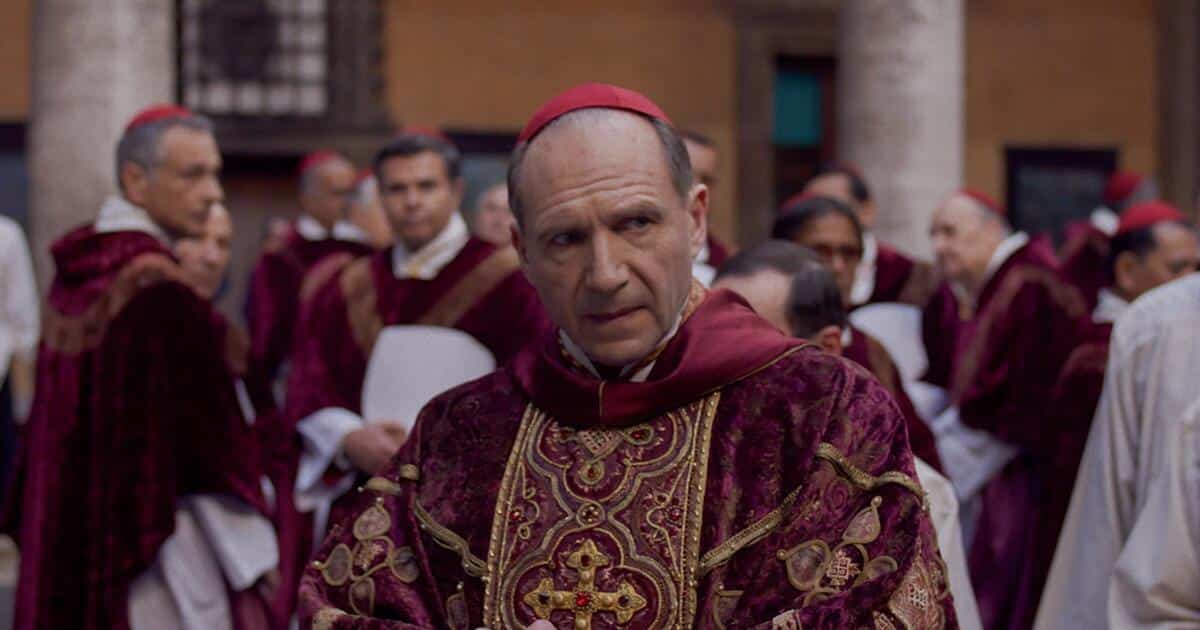
Soon, voters will face a decision: do they support the candidate they truly believe in? Or do they vote to keep a powerful right-wing leader from gaining power? Ideally, these aspirations would coincide, and although this question might already be on your mind, I’m particularly referring to a unique electorate – a group of cardinals, enclosed in the Vatican in Edward Berger’s “Conclave.”
Adapted by Peter Straughan from the Robert Harris 2016 novel, the elegantly crafted and minutely acted “Conclave” embodies these universal struggles within the strictly controlled procedure of electing a new pope. Teeming with clandestine manipulations among the scheming cardinals, as well as a Pakula-like fondness for stairwell whisper campaigns among the individuals in power, “Conclave” is more of a twisted, scandalous ecclesiastical thriller than a philosophical exploration.
Cardinal Lawrence (Ralph Fiennes) is tasked with overseeing the conclave following the pope’s demise—an assignment he is hesitant to assume. A cardinal can only be elected when they receive a majority of 72 votes, and steering this group of argumentative, power-thirsty individuals to reach that number is going to require a monumental effort of gentle diplomacy, perhaps even a divine intervention or two.
This job would likely be simpler for a less scrupulous cardinal. Unfortunately, the responsibility to elect the appropriate pope weighs heavily on Lawrence, and this duty is further complicated by the fact that unpleasant rumors and controversy surround three of the most ambitious candidates: the interfering Cardinal Tremblay (John Lithgow), the overly charismatic Cardinal Adeyemi (Lucian Msamati), and the ultra-conservative, always vaping Cardinal Tedesco (Sergio Castellitto). However, Lawrence prefers to endorse the modestly progressive Cardinal Bellini (Stanley Tucci), who shies away from the opportunity.
The conclave is also disrupted by an unexpected arrival: a cardinal covertly appointed by the pope. The Archbishop of Kabul, the enigmatic Cardinal Benitez (Carlos Diehz), arrives unannounced, his presence causing a stir within the group, a silent bomb ticking away as he emerges as an unexpected underdog in the race for the position.
Lawrence himself outwardly rejects the role, citing a crisis of faith, but some accuse him of secretly harboring such ambitions. Fiennes, whose performance is so understated it’s almost painful, allows a glimmer of hope to cross his carefully controlled expression. If the votes swing in his favor, it might just happen. This subtle subplot, masterfully portrayed by Fiennes, is the true gem of the film.
The secluded political maneuvering degenerates into cafeteria antics and social warfare reminiscent of a high school movie, but this maelstrom of personal drama is anchored by the grandeur and formality of centuries-old rituals: attire, ballots, and hierarchy. Nevertheless, director Berger (“All Quiet on the Western Front”) adopts a contemporary approach to the film’s style. Production designer Suzy Davies presents a set with dramatic contrasts of red, white, and black—stark, shiny surfaces that exude a certain coldness. Cinematographer Stéphane Fontaine leverages the unique grandeur and expanse of the Vatican to deliver stunning compositions and gradual zooms that intensify the pressure of the confined atmosphere. The tense strings of composer Volker Bertelmann’s score aptly depict the gravity of the situation.
However, the richness of the filmmaking, including the compelling performances, masks the fact that the story itself is somewhat flimsy and farcical with plot twists that belittle the intellectual dilemma at the core. The script attempts to grapple with whether the church can progress and adapt to the modern world, but all the subtext is exposed. “Conclave” doesn’t encourage the audience to delve deeper; it bluntly lays out all the questions and answers, then diverts us with a series of surprising turns that, oddly, are all treated with the same level of scandal, even though they do not exist on the same moral plane.
“Conclave” is a film that appears more profound than it truly is. In reality, it’s a middle-of-the-road thriller that dabbles in scandal as it reveals the inner workings of the highly secretive Vatican. While the screenplay’s themes can be extended to broader social and political questions, it fails to offer any fresh insights beyond the simple idea that cardinals, they’re just like us.
Katie Walsh is a Tribune News Service film critic.
Similar posts:
- 2025 Oscars Shockers: Which Movies are Already Creating Unstoppable Buzz?
- Shocking Secrets Behind US Police Exposed in Explosive ‘Power’ Review – You Won’t Believe It!
- Shocking Revelation: ‘The First Omen’ Appeals to Diehards, but Bigger Nun Thrills Await Elsewhere!
- Bad Boys Star Martin Lawrence Shocks Fans: He’s Healthier Than Ever!
- Harrison Ford Raves About Iconic Comedy Scene from 17 Years Ago – Find Out Which One!

My name is Alex Carter, a journalist with a deep passion for independent cinema, alternative music, and contemporary art. A University of California, Berkeley journalism graduate, I’ve honed my expertise through film reviews, artist profiles, and features on emerging cultural trends. My goal is to uncover unique stories, shine a light on underrepresented talents, and explore the impact of art on our society. Follow me on SuperBoxOffice.com for insightful analysis and captivating discoveries from the entertainment world.