
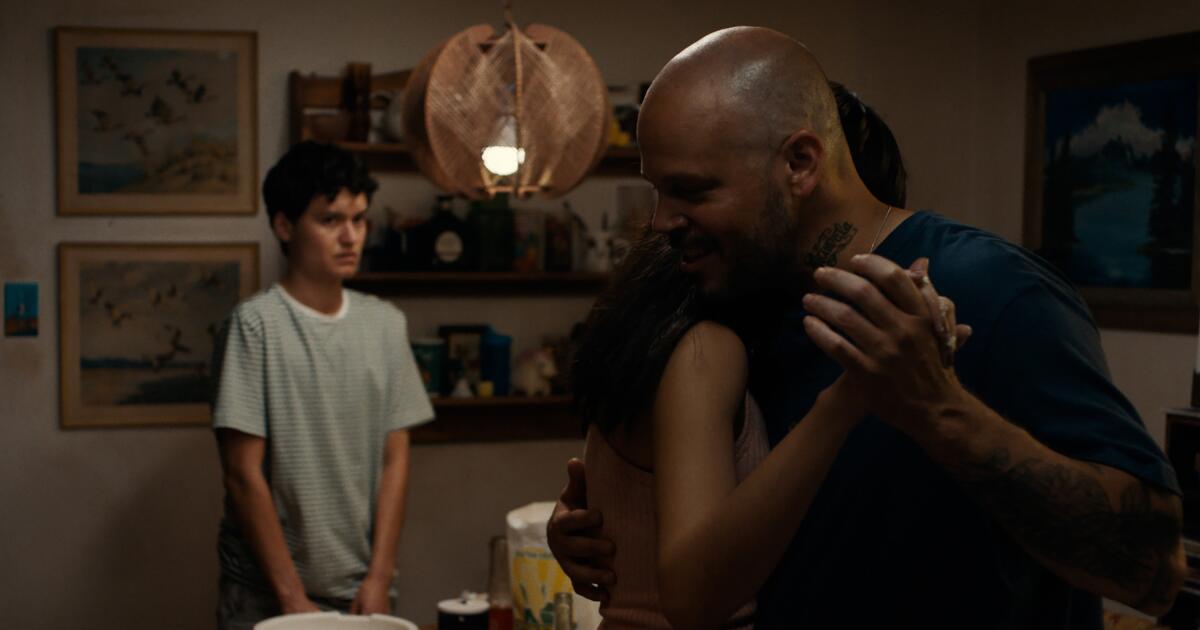
The film “In the Summers” opens with Vicente, a blue-collar guy, waiting nervously in his car. He’s constantly playing with his lighter and drumming on the steering wheel to ease his anxiety. He’s eagerly waiting for a pivotal moment in his year to begin — the period that defines his identity. His young daughters finally appear from the airport, and he rushes to greet them. Summer is the time when he becomes a father. Summer is his opportunity to prove his worth.
Presented in four parts spanning nearly two decades, this beautiful first feature by Colombian American writer-director Alessandra Lacorazza may remind audiences of unique indie films like “Moonlight” and “Aftersun” in its structure and themes. However, this subtly powerful autobiographical drama is so accurately and insightfully depicted that it stands on its own emotional ground. The film not only tells the story of a father but also of his little girls who won’t be little forever.
The opening chapter sets the narrative structure. Vicente, portrayed by rapper René Pérez Joglar (also known as Residente), resides in Las Cruces, N.M., in his deceased mother’s house. After his divorce, he moved here and now has summer custody of his daughters, Eva (Luciana Quinonez) and Violeta (Dreya Renae Castillo), who typically live with their mother in California. Despite their young age, Eva and Violeta can see their father’s hidden stresses. Vicente drinks a bit too much and loses his temper too quickly. He strives to show his daughters a good time in Las Cruces but his real goal is to prove to them that he is an exceptional father. He may not mention the divorce, but he’s still wrestling with its aftermath.
The initial segment concludes on a curious, ambiguous note as Violeta impulsively decides to cut her hair short, which agitates her more conservative father. This incident informs much of the subsequent narrative. Like “Moonlight,” “In the Summers” progresses through time in its three following chapters. We observe the transformation in the father-daughter relationship during these crucial summers as Eva and Violeta return to Las Cruces. (Older actors portray the daughters in later chapters.) Lacorazza, a director who favors showing over telling, resists grand speeches that expose the characters’ mental states. Instead, recurring images across chapters reveal it all. Just observe as Vicente’s once immaculate backyard pool progressively deteriorates due to neglect.
As the winner of the Grand Jury Prize and the Directing Award at the Sundance of this year, “In the Summers” is inspired by Lacorazza’s memories of her late father. The film’s most shocking scene, a car ride that serves as the ending of the second part, is a near-accurate reenactment of a real-life incident. A filmmaker drawing from personal experiences may risk losing perspective as the incidents are intimately known to her but alien to the audience. However, this meticulously observed, patiently constructed drama’s structure becomes clear, and each new chapter possesses a captivating suspense.
What changes have the three characters undergone since we last saw them? And how might this new summer heal or exacerbate the unseen wounds inflicted in the previous chapter? Lacorazza’s film is one of subtleties, with the daughters in the later chapters subtly revealing the accumulated disappointment and persistent love these women still hold for their flawed father. Vicente and his daughters struggle to directly address the growing rifts between them over the years. Lacorazza maintains this tension, with her characters’ melancholic smiles speaking volumes.
The rotating actors who portray Eva and Violeta deliver excellent performances, particularly Sasha Calle and Lío Mehiel in the final chapter, which reinforces Lacorazza’s contemplation on resignation and acceptance. But Vicente, played by Pérez Joglar, echoing Paul Mescal’s troubled Calum in “Aftersun,” is both the film’s focal point and its biggest enigma. Vicente, a frustrating mix of good intentions and self-damaging habits, is proud of his knowledge in math, physics, and astronomy, which he enjoys sharing with his daughters. However, his belief that life has dealt him unfair cards and his consequent resentment towards everyone around him is also evident. It’s a performance filled with suppressed bitterness, and the pain is most evident once Vicente realizes that his children’s unquestioning admiration for him will fade over time. Despite his efforts to show them that he’s an amazing father, he can’t hide his shortcomings, and his insistence on maintaining this illusion becomes the film’s tragedy. Just like his daughters, we never fully see Vicente as he is determined to conceal his true self.
But families have a unique understanding of each other that outsiders can never fully comprehend. Interestingly, Lacorazza chooses not to include subtitles for the film’s Spanish dialogues. Vicente occasionally speaks Spanish with his daughters, who understand him but prefer to converse in English. According to Lacorazza, this decision was made to allow audiences to connect with emotions that transcend language. For non-Spanish speakers, this choice achieves the intended effect.
This choice adds another layer of depth to this nuanced, sophisticated portrayal of class, sexuality, and parenthood. There may be instances in “In the Summers” when you won’t understand everything that’s being said. But the characters do, sharing a private language of family dysfunction and unspoken pain. The rest of us can only observe — we might even understand the essence of their conversations — but their world is exclusively theirs. The fact that Lacorazza has expressed her complex emotions towards her father while acknowledging that words can sometimes fall short, as shown in the silently heartbreaking final scene, speaks volumes about the profound impact of this film.
Similar posts:
- Get Summer-Ready Gorgeous! Free Series Binge-Watch Guide Here!
- Shocking: Inmates Reunite with Kids for One Night in ‘Daughters’ – A Tear-Jerker Review!
- Shocking Secrets Revealed in ‘His Three Daughters’! Must See Drama!
- Rob Schneider Pleads for Daughter Elle King’s Forgiveness After She Brands Him ‘Toxic’!
- Gabriel Byrne Unmasks Samuel Beckett: Reality vs Myth in ‘Dance First’ Biopic EXPOSED!

My name is Alex Carter, a journalist with a deep passion for independent cinema, alternative music, and contemporary art. A University of California, Berkeley journalism graduate, I’ve honed my expertise through film reviews, artist profiles, and features on emerging cultural trends. My goal is to uncover unique stories, shine a light on underrepresented talents, and explore the impact of art on our society. Follow me on SuperBoxOffice.com for insightful analysis and captivating discoveries from the entertainment world.