
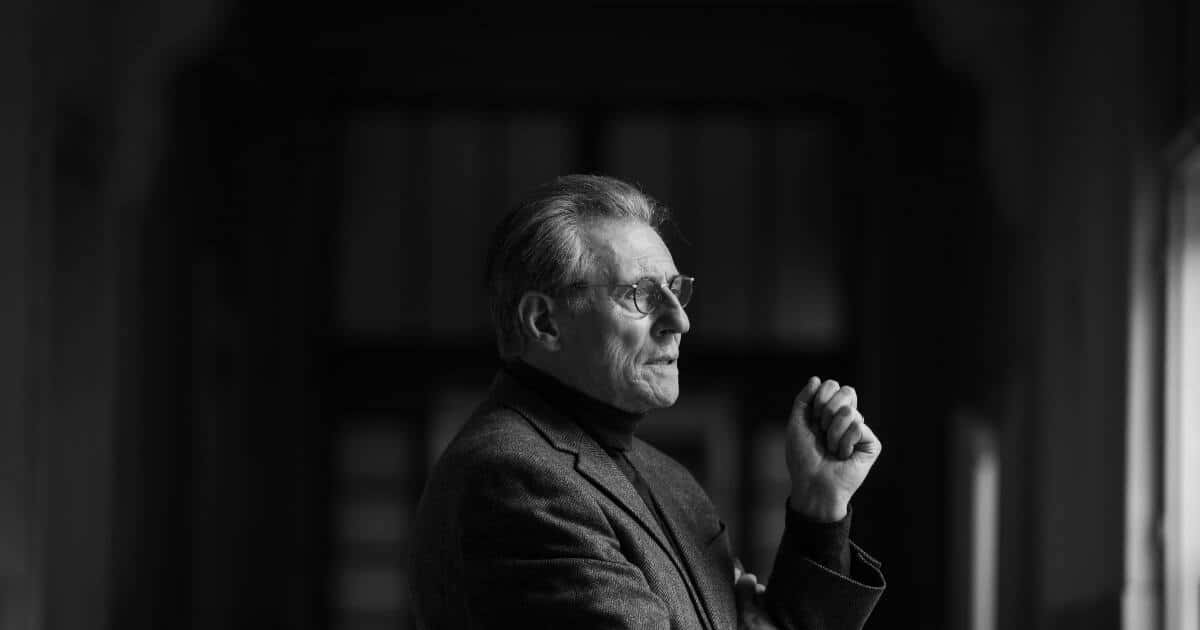
Samuel Beckett, a renowned Irish writer who moved to Paris and was greatly influenced by the French language, is known for his groundbreaking contributions to literature in the latter half of the 20th century. The thought of a traditional biopic seems contradictory to Beckett’s distinctly modernist mindset, given his aversion to the often feel-good and sentimental nature of such films.
Notoriously private, Beckett, who passed away in 1989, was not fond of self-promotion or publicity. So, it’s quite probable that he wouldn’t have enjoyed being the subject of a movie. Upon learning that he was to receive the 1969 Nobel Prize in Literature, Beckett retreated to a hotel in Tunisia to avoid the inevitable fanfare. He promptly informed Swedish officials that, while he was honored by the award, he would not be attending the ceremony.
James Marsh’s film “Dance First”, a black and white portrayal of Beckett’s life captured by cinematographer Antonio Paladino, doesn’t let this small detail deter its opening. The movie starts with Beckett (portrayed by Gabriel Byrne) at his Nobel Prize celebration in Stockholm, dressed as if he is attending a funeral. He turns to his wife, Suzanne Dechevaux-Dumesnil (Sandrine Bonnaire), and whispers, “Quel catastrophe!” as the praises of his literary accomplishments are recited from the stage.
Interestingly, it is believed that the remark about the catastrophe was actually made by Beckett’s wife, who was also uncomfortable in the limelight. However, screenwriter Neil Forsyth takes a daring turn from realism to surrealism.
In an unexpected departure from reality and etiquette, Beckett disrupts the ceremony, seizes the check, and proceeds to climb the wall to evade public attention. He then finds himself in an ancient setting that could easily be the backdrop for a Greek tragedy or even one of his own plays, where he engages in a thought-provoking dialogue with his alter ego.
Byrne, portraying both sides of Beckett’s consciousness, brings these characters to life. His formal Beckett, filled with somber remorse, explains that he accepted the award to donate the prize money. However, his casual, nonchalant Beckett double inquires, “Whose forgiveness do you need the most?”
The movie is broken down into flashback chapters about those who left a mark on Beckett’s conscience. This structure, albeit a bit contrived, allows for an easy division of his life into digestible segments.
The film’s title is a reference to a line in Beckett’s “Waiting for Godot” that prioritizes dancing over thinking. However, other than that, “Dance First” shares little with Beckett’s absurdist aesthetic.
Beckett, with his unwavering commitment to minimalism, revolutionized any artistic medium he worked in. His works, such as “Waiting for Godot” and “Endgame,” novels like the Beckett trilogy (“Molloy,” “Malone Dies” and “The Unnamable”) and even “Film,” his 1965 venture into screenwriting, stripped away all nonessentials. He defied traditional expectations to explore what could be conveyed when all unnecessary elements are discarded.
In Beckett’s work, meaning is not imposed but is instead crafted through a seamless union of style and content. On the contrary, Forsyth’s screenplay for “Dance First” serves as a vessel for biographical recounting and interpretation. The film has a journalistic vibe, providing a comprehensible summary of Beckett’s life, with all the significant events neatly listed.
What redeems the film is its compassionate endeavor to delve beyond the myth to understand the man. Byrne’s portrayal of Beckett may be less stern, both outwardly and inwardly, than the writer’s prevailing image. With an aura of tired melancholy, he conveys an unexpected desire for confession and unapologetically portrays an aging Beckett nearing the end of his life. As physical hardship is a consistent source of dark humor and a metaphor for the human condition in Beckett’s writing, the depiction of mortal decline is apt.
Nevertheless, an aura of artificiality permeates the film, even though it adheres to a factual framework. By condensing Beckett’s journey into a series of concise, self-contained chapters, “Dance First” inevitably distorts and over-dramatizes.
Beckett’s complicated relationship with his demanding and disapproving mother, May (Lisa Dwyer Hogg), is the first stop on his guilt trip. The young Beckett (played by Fionn O’Shea) left Ireland partially to escape her control, but the film fails to hint at other aspects of a bond that would influence Beckett’s work throughout his career.
The sections about Lucia Joyce (Gráinne Good), James Joyce’s mentally ill daughter who believed Beckett would marry her, and the scenes documenting Beckett’s involvement in the Resistance during World War II are summarized in a way that feels contrived. Nonetheless, the performances occasionally transcend the summary treatment.
The interactions between O’Shea’s Beckett and Aidan Gillen’s James Joyce, who initially resisted but eventually appreciated the young man’s reverence and diligence, are depicted with refreshing complexity. Gillen’s Joyce identifies in Beckett not only a protégé but also a potential spouse for his unstable daughter — a plan that incites his practical wife, Nora (Bronagh Gallagher), who is much more straightforward in her manipulations.
Beckett’s emotional detachment and his ability to resist falling prey to others’ needs, allow him to become the acclaimed writer, but this comes at a price which becomes more apparent as the film shifts its focus to Suzanne (Sandrine Bonnaire). Bonnaire and Léonie Lojkine, who plays the younger Suzanne, not only retain the character’s dignity but also her strategic intelligence and discretion.
Suzanne understands the demands of being Beckett’s wife, shielding him from anything that could detract from his higher purpose. It’s not clear whether Beckett would have realized his potential without the stability she provided. He was faithful, in his own way, to the woman who stayed by his side when he was recovering from a near-fatal stabbing in a random act of street violence in 1938. She was also bravely by his side during their risky war years working with the Resistance.
When Barbara Bray (Maxine Peake), the BBC script editor who becomes Beckett’s long-term lover, enters the picture, Suzanne skillfully navigates the precarious marital situation. The pain Beckett causes both women is silently reflected on his ruggedly handsome face. He may be self-absorbed, but it would be incorrect to consider him heartless.
Words fall short in expressing the pain he has inflicted, but Beckett manages to artistically express it in “Play,” his audacious one-act where a husband, wife, and mistress quickly retell their story of infidelity while stuck in funeral urns in an undefined afterlife.
Despite his reputation for gloominess, Beckett was also a sports enthusiast who enjoyed rugby, cricket, tennis, attractive women, male companionship, and fine whiskey. O’Shea’s portrayal allows for this other side of Beckett, while Byrne’s more withdrawn version of the character seems more suited for a monastery or academic library.
However, the emotional depth of a writer who experienced emotions too deeply to resort to cheap sentimentality is still evident. “Dance First” may not be particularly Beckettian, but it humanizes a figure who, destined for greatness, never forgot his humanness — all too human indeed.
Similar posts:
- Shocking Truth Unveiled: Native Women – Both Heroes and Victims in Haunted ‘Fancy Dance’
- Viola Davis Shockingly Named Next Cecil B. DeMille Award Recipient at Golden Globes!
- Action-Packed Martial Arts Series Scores 4/5 – Explosive Season 2 Returns!
- Shocking Pic Reveals Marlon Brando’s Hidden Homoerotic Swagger in Leather!
- Director Demands Hollywood to Boost Native Languages, Starting with ‘Fancy Dance’

My name is Alex Carter, a journalist with a deep passion for independent cinema, alternative music, and contemporary art. A University of California, Berkeley journalism graduate, I’ve honed my expertise through film reviews, artist profiles, and features on emerging cultural trends. My goal is to uncover unique stories, shine a light on underrepresented talents, and explore the impact of art on our society. Follow me on SuperBoxOffice.com for insightful analysis and captivating discoveries from the entertainment world.