
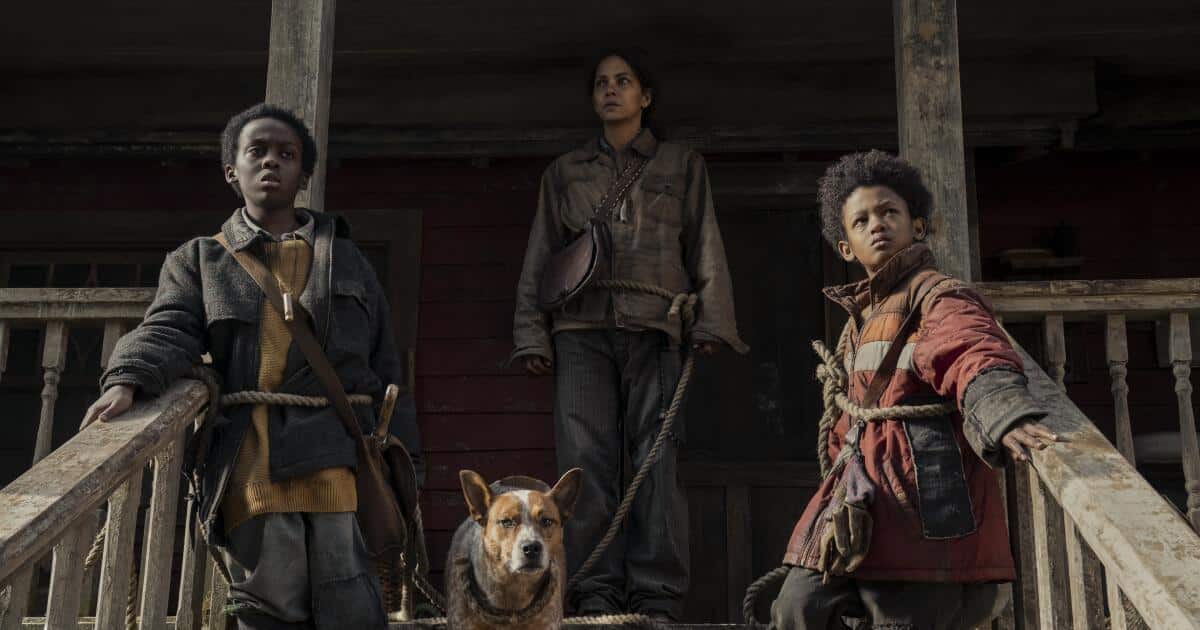
Hollywood’s latest psychological thriller, “Never Let Go,” directed by Alexandre Aja, comes across in its trailer as a ghost story. The film features Halle Berry, who portrays a distressed mother in an apparent post-apocalyptic scenario, secluded in a forest with her two young sons. To safeguard her family from unseen dangers, she adheres to a ritual of tying ropes from their decaying log cabin, an act that could be interpreted as either superstitious or supernatural.
However, “Never Let Go” is not a typical ghostly thriller. It unfolds as one of the most unexpectedly dark American genre movies in recent times. Considering that Aja is a French director previously linked with the New French Extremity and was cited as a member of the so-called “Splat Pack” of emerging horror directors in the early 2000s, this might not come as a shock. Aja’s earlier work, “High Tension,” delivered exaggerated violence in a stylized manner, and he’s recognized for his delightfully over-the-top creature films such as “Crawl” and “Piranha 3D”. However, “Never Let Go” signifies a shift towards more grave storytelling.
As one starts to suspect early on (and as several YouTube critics have already presumed), the “evil” that Berry’s character in “Never Let Go” warns and safeguards against is possibly a figment of her imagination. Her son, played by Percy Daggs IV, begins to question his mother’s peculiar practices and the regulations governing their lives: the ropes, the ritualistic blessings, and periods confined in a small basement meditating on concepts of “love” and “evil”.
But it’s only the mother who can see the ghostly apparitions of her deceased mother and husband, and her sons have to believe that she’s protecting them, even as their resources run low. The plot becomes a grim survival challenge as it becomes apparent what’s actually happening, watching a mother torment her starving children with her delusions.
The dialogue-heavy script, penned by K.C. Coughlin and Ryan Grassby, does little to improve the situation. It begins with a narration by the character Nolan, reminiscent of “Beasts of the Southern Wild,” another film about young Black children surviving in the wilderness. This narrative thread continues throughout the film, explaining what Nolan and his brother, Samuel (played by Anthony B. Jenkins), have learned from their mother about their existence within the confines of the house and the non-existence of an external world. The excessive exposition, unnecessary chapter titles stating obvious themes, and a lack of visual storytelling make the script less engaging.
The film’s atmosphere is haunting and eerie, largely due to the impressive production and costume design. The claustrophobic house, seemingly frozen in time, is set amidst a moist, moss-covered forest. With themes of isolation and family manipulation, it evokes comparisons with films like “Dogtooth” and “The Village”, only with added misery.
The film’s sound design carries much of the load when it comes to the jump scares, although we quickly learn to question what we hear. Aja’s ability to set the mood and tone, combined with an unsettling spectral camera work, is impressive, but the visual rules of this world are not consistently applied. This becomes surprisingly evident in a story that otherwise clearly defines the family’s practices and rituals. The terrifying visions become confusing as it’s unclear who sees what and why.
Despite the inconsistencies, the film’s imagery has a metaphorical quality, requiring viewers to suspend disbelief even if everything does not neatly tie up in the end. Daggs delivers a nuanced performance for such a young actor, and Jenkins oscillates effectively between being heartbreaking and threatening.
However, “Never Let Go” becomes a grueling journey for a significant part of its runtime. It’s distressing to see innocent characters being mistreated or endangered, and the film includes several distressing sequences in the middle that are almost unbearable to watch, without any satisfying resolution or justification.
It’s unusual to see an American film taking such a relentlessly dark stance towards children and animals. It feels more akin to a grim and bleak Eastern European film than a conventional spooky thriller. While some may appreciate this approach, for others, it may come as an unwelcome surprise.
Walsh is a Tribune News Service film critic.
Similar posts:
- Get Summer-Ready Gorgeous! Free Series Binge-Watch Guide Here!
- Charlie Hunnam as Ed Gein: Shocking First Look at Netflix’s New Monster!
- Shocking Truth Revealed: Adults, Not Kids, Are the Real Trouble!
- Game of Thrones and X-Files Stars in Netflix’s New Western Series – First Trailer Drops!
- Netflix’s New Western Series from Yellowstone Creator: Fans Are Going Wild!

My name is Alex Carter, a journalist with a deep passion for independent cinema, alternative music, and contemporary art. A University of California, Berkeley journalism graduate, I’ve honed my expertise through film reviews, artist profiles, and features on emerging cultural trends. My goal is to uncover unique stories, shine a light on underrepresented talents, and explore the impact of art on our society. Follow me on SuperBoxOffice.com for insightful analysis and captivating discoveries from the entertainment world.