
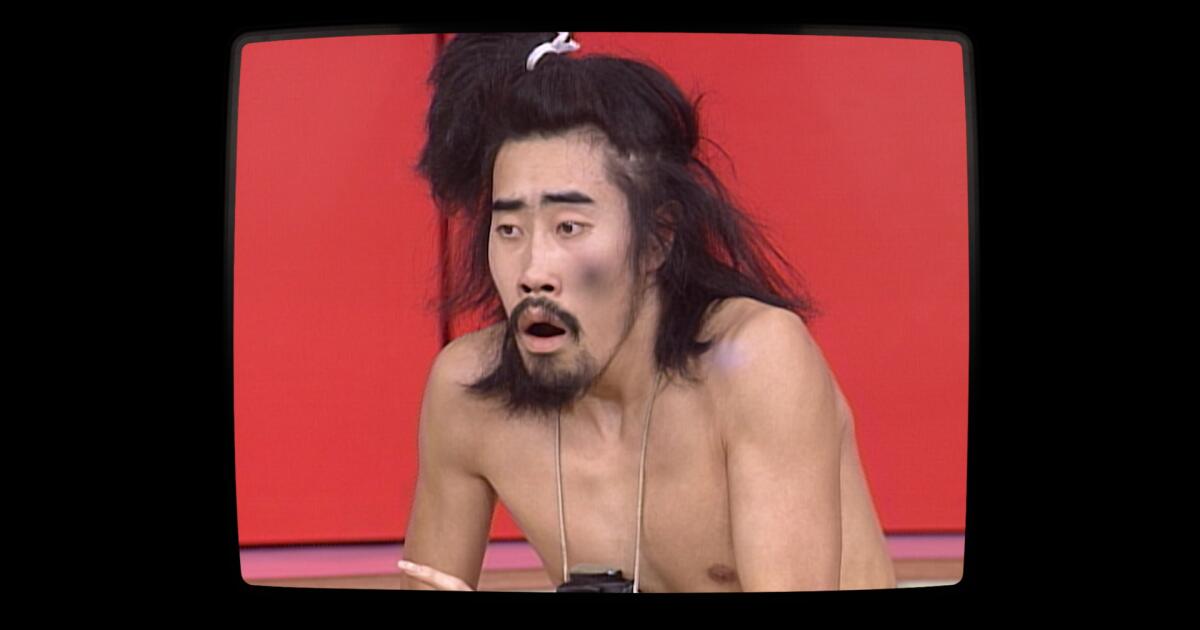
In the early days of 1998, a budding Japanese comic by the name of Tomoaki Hamatsu, who was more affectionately known as Nasubi — or “eggplant,” due to his elongated face — was selected to be the lead in a popular variety show called “Susunu! Denpa Shōnen.”
The show, conceived by producer Toshio Tsuchiya, spotlighted young contestants participating in extreme trials — imagine a mashup of “Saturday Night Live” and “Jackass.” Nasubi was picked to compete in a segment termed “A Life in Prizes,” a concept inspired by the magazine sweepstakes that were a hit in Japan during the 1990s.
What was supposed to be a crowning achievement for the 22-year-old from Fukushima turned into one of the most peculiar and disturbing episodes in television history. It is now the focus of a documentary, “The Contestant,” directed by Clair Titley and debuting on Hulu this Thursday.
Unlike other contestants on “Denpa Shōnen” who embarked on international adventures, Nasubi was transported to a small apartment equipped with a tiny table, a collection of magazines, and a pile of blank postcards. Here, he was instructed to strip off his clothing, with only a strategically positioned pillow to maintain his decency on screen.
Per the rules of the challenge, created by Tsuchiya, Nasubi was only permitted to sustain himself with the prizes he won from magazine sweepstakes. To enter these sweepstakes, he had to fill out thousands of postcards. Once he had accumulated prizes worth a million yen — roughly $8,000 — he would be released. Until that time, Nasubi would be in isolation, with his only human interaction being the occasional check-in from Tsuchiya.
In a surprising turn of events, Nasubi endured the challenge for over a year, subsisting on half-cooked rice and dog food while suffering emotional torment as Tsuchiya devised cruel new plot twists for what essentially became a televised psychological experiment. This accomplishment made Nasubi one of Japan’s biggest TV stars — although he was completely unaware of it.
Despite knowing he was being filmed, Nasubi was informed that the footage would be broadcasted at a later date, with most of it expected to be unused. In reality, his harrowing journey was aired weekly on “Denpa Shōnen,” complete with eccentric graphics (including an eggplant emoji to cover his private parts) and over-the-top sound effects. Thanks to the cutting-edge technology of the time, viewers could even tune into a 24-7 livestream online.
Like the main character in “The Truman Show” — which premiered in June 1998 — Nasubi was entirely ignorant of his celebrity status until his ordeal was over.
Utilizing extensive footage from “Denpa Shōnen” along with interviews with Nasubi, his family, and Tsuchiya, “The Contestant” provides a disconcerting glimpse at one man’s accidental brush with fame — and the unexpected trajectory he followed years after becoming a national sensation.
Several years ago, while working on a different project, Titley stumbled upon Nasubi’s story on the internet.
“I kept uncovering articles, but most of them presented a rather simplistic version of his story and almost seemed to mock Japanese culture — kind of like, ‘Look at how weird they are,’” the director noted during a recent joint interview with Nasubi. “No one seemed to delve deeply into Nasubi’s story.”
With the assistance of a neighbor who was fluent in Japanese, Titley initiated a correspondence with Nasubi. After several exchanges, he traveled to the U.K. in 2018 to discuss a possible collaboration with her. “We embarked on a small tour around the U.K., and with the help of the interpreter, we chatted about his story and indulged in numerous games of table tennis,” Titley recalled.
“We had a truly remarkable time,” Nasubi expressed through an interpreter. “I concluded that this is someone I can trust wholeheartedly.”
Titley and Nasubi discussed the making of “The Contestant,” the surreal chapter in his life, and audience reactions to the film with The Times. This conversation has been edited and condensed, and it contains mild spoilers.
[To Titley] What intrigued you about the topic?
Titley: Like most people, I was pondering, “How could this possibly happen? Is this for real? Why didn’t he leave?” All those standard queries, but then also, how has this impacted him and what type of person has he evolved into as a result of this experience? Everything [written about Nasubi] seemed to halt the moment he exited “Denpa Shōnen” and hadn’t truly explored what transpired after.
[To Nasubi] Were you hesitant to revisit this? Why was Clair [Titley] the right person to narrate this story?
Nasubi: I received considerable attention from foreign media — radio, TV, magazines. They all wanted to interview me. But a documentary film? I considered that a special proposal. I knew nothing about Clair. She reached out to me through Facebook. Some people questioned, “How could you trust this person so easily?” But she mentioned she had found a Japanese interpreter, and they both seemed very genuine. I decided to be open-minded. Although I may have been deceived during “Denpa Shōnen,” my philosophy is that it’s better to be deceived than to deceive others.
How did you manage to get Tsuchiya to participate?
Titley: We contacted him via Nasubi. He did not show any reluctance. I have immense respect and gratitude for his participation in the [film], as he didn’t impose any conditions. He was very open, honest, and quite courageous. He’s a filmmaker himself. He’s not clueless. He’s aware of how he will be perceived in the West. My belief is that perhaps he participated as a sort of apology to Nasubi.
I didn’t feel the need to inform the audience that his actions were questionable or unethical. I didn’t think I needed to make that clear to anyone. If anything, I believed it was more interesting if we gave him the room and the space — not to justify himself, but to explain himself.
[To Nasubi] Had you actually watched any of the footage prior to making this documentary?
Nasubi: I attempted to watch it numerous times but emotionally it was very challenging. I simply couldn’t do it. It might be tolerable for people to watch, but I felt degraded watching myself in that situation.
Did that feeling of degradation ever dissipate?
Nasubi: Gradually, my consciousness was altering. When I tried to work as an actor or comedian, I received numerous offers, but they would often inquire, “Are you willing to appear naked?” Or even without [me] being naked, they wanted to reproduce something that I had experienced, so it was just like reverting to the same thing. I felt like I was carrying a heavy burden on my back, so weighty that I couldn’t stand up straight.
The significant shift occurred in 2011, when the earthquake struck Japan. I’m from Fukushima. I had to participate in some rescue operations, and I met many people who were genuinely thrilled to see me. They frequently told me, “I drew so much strength from you by watching the show. Your presence here invigorates us.” I realized that I could transform my struggle into something positive and support people and bring joy to people. I can’t alter the past, but I might have the power to shape the future.
What do you believe enabled you to endure so long in “A Life in Prizes”?
Nasubi: I myself thought it wasn’t going to last. How could anyone survive solely on contest prizes for such an extended period? I assumed the maximum would be one or two months. It was extremely mentally taxing. You start to think it’s safer to remain in the same environment than to alter the environment. I was trapped both physically and mentally as a result. I also wanted to demonstrate mental resilience, simply because this is something that I decided I would participate in, so I did not want to quit. I wanted to persevere until the end. Physically it was difficult, but that’s something you can overcome. Your body will adapt. The isolation, the loneliness — that was the toughest part.
What was the nadir for you?
Nasubi: When I completed [the challenge] in Japan, but then I was transported to Korea and I had to commence again. That was my lowest point. That was incredibly difficult. I didn’t think anything that hard would ever occur to me in my life. When Tsuchiya was instructing me to remain in Korea, he said that all the anger emerged, like every cell — he actually perceived it rising from my body. I was furious.
That is probably the most difficult scene to watch in the film. What kind of reactions have you observed from audiences?
Titley: In terms of audience reaction, what I’ve truly appreciated about it is that people have come out of it angry at how Nasubi’s been treated, but not depressed, they’re optimistic, which I think is what we aimed to achieve. People feel moved and inspired by Nasubi.
They’ve identified numerous different themes as well. You make a film and you’ve got this clear concept about what it’s about. Then when you share the film, suddenly it becomes everyone else’s as well. I had people at the first few festivals who stated, “It’s great that you’ve made this film all about coercive control, and it’s so important for the domestic violence community.” It was great that it resonated with them.
For me, it’s very much a film about a man seeking connection, perhaps initially in the wrong places, and then he discovers it in unusual places.
Perhaps because I’m an American, I watched this and wondered if anyone ever considered suing or taking legal action.
Titley: Japanese society tends to be less litigious than the U.K. and the U.S. The other factor is that back then, there was no precedent. Now we’ve got 20 years of reality TV history to look back on. If you went on a reality TV show [today], you know you might be manipulated. But back then, even the people producing the shows didn’t really comprehend what they were doing. They were improvising as they went along.
Nasubi: I wasn’t familiar with the term “sue.” Speaking with the Western press, now I’ve learned the term “sue.” People often approach and say, “This is a human rights violation and you should sue.”
But [back in 1998], Tsuchiya was very popular. Once you appeared on his program, you were assured fame. [“Denpa Shōnen”] was a show that every aspiring actor and comedian yearned to be a part of.
Instead of harming other people by suing them, just to acquire some money for myself, I decided to accept my past. I was more focused on accepting my life. I feel like I can transform that hatred and anger — that negative energy — into positive energy within myself.
Are there ways that this affected you and still impact you now, either physically or mentally?
Nasubi: I don’t wish to write postcards anymore. I’ve done enough for a lifetime. I can still stomach kimchi [which he lived on when he was relocated to Korea], but I’m not particularly fond of it. Initially, it was difficult for me to wear clothes. My skin physically changed. When [the challenge] concluded, and I was in the TV studio, [“Denpa Shōnen’ host Akiko] Matsumoto touched my skin, she remarked, “It feels like elephant skin.” Because I hadn’t worn clothes for such a long duration, my skin became thicker, like clothing. If I wore clothes, then I would perspire.
What do you want people to understand about you now?
Nasubi: I can empathize with people in difficult situations — with vulnerable individuals. I’m not sure I can heal those people with this film, but perhaps I can offer them something. If I can utilize my past, my struggles in life, to help others feel like it’s okay to continue, then I feel like my past was not a waste. It was something beneficial.
Similar posts:
- Billy Dee Williams Shockingly Supports Blackface in Acting: ‘You Should Do It’!
- 13 Reasons Why Star QUITS Netflix Show – Uncover the Shocking Reasons!
- Netflix’s ‘My Little Reindeer’ Mystery: Creator Reacts as Fans Race to Unmask the Attacker!
- Anne Hathaway’s Shocking 5-Year Sobriety Triumph Outshines Her ‘Middle Age’ Milestone!
- Marvel Star Evangeline Lilly Quits Acting Forever?! Shocking Reasons Revealed!

My name is Alex Carter, a journalist with a deep passion for independent cinema, alternative music, and contemporary art. A University of California, Berkeley journalism graduate, I’ve honed my expertise through film reviews, artist profiles, and features on emerging cultural trends. My goal is to uncover unique stories, shine a light on underrepresented talents, and explore the impact of art on our society. Follow me on SuperBoxOffice.com for insightful analysis and captivating discoveries from the entertainment world.