
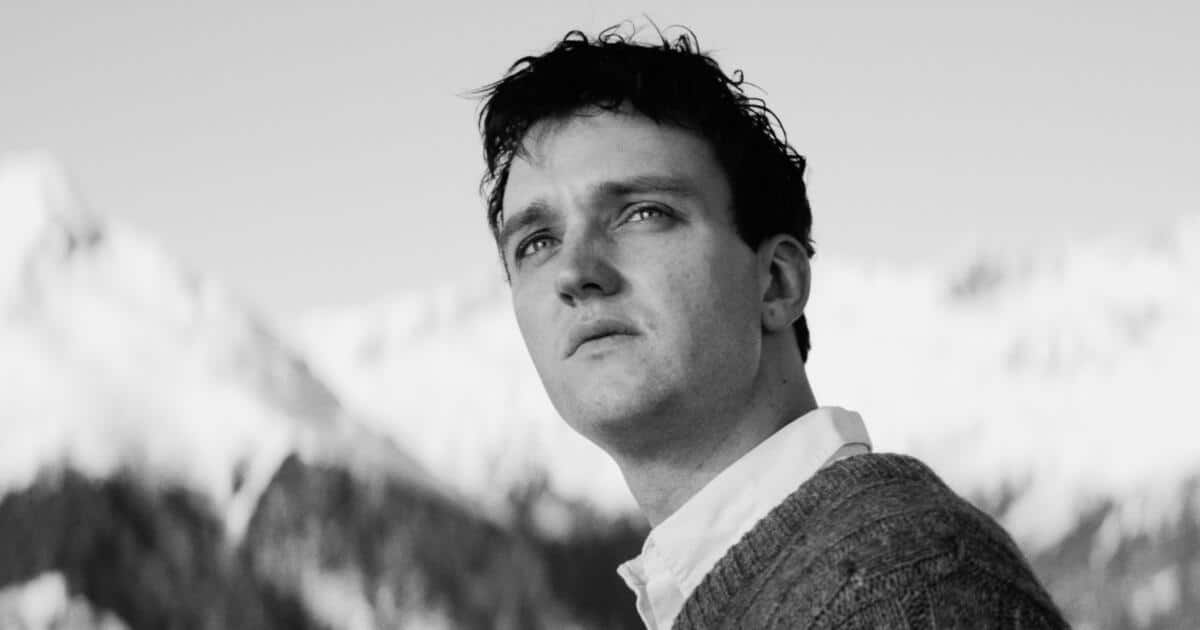
We might not be trapped in the Matrix, in a literal sense. However, from a cinematic perspective, we are certainly living in a world that has been heavily influenced by “The Matrix” and its concept of a multiverse. This is not only evident in the plethora of superhero movies and award-winning films like “Everything Everywhere All at Once”, but also in the more opulent atmosphere of mystique and impending doom that permeates the German import “The Universal Theory”. This film is a post-WWII art thriller set against the backdrop of the strikingly beautiful Swiss Alps and revolves around a prodigy in quantum physics and a mystifying jazz pianist.
Some might call it blanc noir, or high-fidelity science fiction, or even a matinee treat for the likes of Niels Bohr and Erwin Schrödinger. There’s no doubt that it’s a dreamlike montage of the era’s brooding, existential films. Timm Kröger, the co-writer and director, masterfully captures the chilly discomfort of Antonioni, Welles, and Tarkovsky while also channeling a lot of Hitchcock vibes, primarily through an impressively grand orchestral score (by Diego Ramos Rodriguez) that could easily pass as a forgotten symphony of Bernard Herrmann. The black-and-white cinematography by Roland Stuprich only enhances the effect.
The movie opens with a kitschy ’70s talk show where the visibly shaken author Johannes (played by Jan Bülow) insists that his best-selling novel about parallel worlds is not a work of fiction, a claim that the host dismisses with cynical humor. The story then shifts to the grayscale widescreen of the early ’60s, where an intellectually gifted but socially awkward PhD candidate Johannes (now noticeably less blotchy) is working on his thesis and traveling to a conference at a ski lodge with his irritable mentor, Dr. Julius Strathen (Hanns Zischler).
Strathen is far from impressed by what he considers “metaphysical nonsense”, which is precisely where Johannes’ interests lie, especially in the universal wave function that suggests the existence of multiple realities. At the conference, Johannes finds an intellectual ally in Strathen’s old adversary, the flamboyant Blumberg (Gottfried Breitfuss). But he is also inexplicably attracted to a coldly beautiful, cryptic musician, Karin (Olivia Ross), who seems to know his deepest childhood secrets and oscillates between telling Johannes to “Leave me alone” and passionately kissing him after warning him to “Be careful”.
There’s definitely something amiss at the conference, with bizarre deaths, malfunctioning elevators, an outbreak of nasty skin infections among the guests, and the unearthing of an underground tunnel. And let’s not forget the growing suspicion that people are not who they claim to be. Or were. Or will be? (And you thought studying was challenging enough.)
Even without a master’s degree in wave-particle duality, one can appreciate the cosmic playground of coincidence and destiny that Kröger has created. That being said, the director, who is making his debut feature film as a cinematographer, doesn’t quite reach the level of subconscious-dissolving genius of David Lynch. “The Universal Theory” is a tad lengthy and ultimately a cerebral piece rather than an emotional one, despite the grandiose orchestral score constantly brimming with intent. The performances too, while accurate, lack depth, which is, admittedly, consistent with the complexities being portrayed.
Nevertheless, Kröger has a natural flair for the style and rhythm of classic movies. He knows how to subtly manipulate the familiarity of composition and story to keep us engaged until the end, when he abandons the snowy Swiss landscape to wrap up the rest of the story (which includes a “film” of Johannes’ book that neatly ties up the cycle of life-simulation-cinema). All in all, the film is a sequence — or perhaps two — of events, remorse, memories, and specters (and a love for movies) that would fit right in with one of Lars von Trier’s early works, like 1991’s “Zentropa”. While “The Universal Theory” may not blow you away, as it delves into its meticulously designed tale of conspiracy and disorder, you’ll realize that the eccentricities of art house cinema are very much alive.
Similar posts:
- Stephen King’s Secret Game Changer in HBO’s Derry Series – You Won’t Believe It!
- Jeymes Samuel’s ‘Nazarene’: A Heartfelt Ballad or a Secret Prayer? You Decide!
- Monster High Beats Barbie! Universal’s Epic New Film Based on Mattel Dolls Shocks Fans!
- Stranger Things: Shocking Fan Theory Hints at Eddie’s Explosive Return in Season 5!
- Hidden Stranger Things Season 5 Episode Crashes Netflix: What’s the Story?

My name is Alex Carter, a journalist with a deep passion for independent cinema, alternative music, and contemporary art. A University of California, Berkeley journalism graduate, I’ve honed my expertise through film reviews, artist profiles, and features on emerging cultural trends. My goal is to uncover unique stories, shine a light on underrepresented talents, and explore the impact of art on our society. Follow me on SuperBoxOffice.com for insightful analysis and captivating discoveries from the entertainment world.