
The French monks who pioneered tennis in the 12th century would surely be astonished to see how Luca Guadagnino’s “Challengers” portrays their beloved game—originally called jeu de paume, or “game of the palm”—as a vehicle for pent-up sexual tension. The intimacy starts with the tennis racket itself. Stiff at one end and flexible at the other, its parts—the shaft, throat, head, rim, butt—are suggestively named. There’s a moment in “Challengers” where a player nestles his fuzzy ball into the throat of his racket, and the innuendo is unmistakable.
And then there’s the profuse sweating and even more visceral sounds of athletes releasing inhibitions as they grunt, pant, gasp, shriek, and swear. For Zendaya’s character, the formidable Tashi Duncan, the purest form of tennis is when she becomes so absorbed in her body’s movements that the outside world fades away. At the climax of her victories, Tashi lets out an exultant scream. Her exhilaration is palpable. You can’t tear your eyes away.
Guadagnino excels at making films about characters with obsessive passions that are infectious, whether it’s dance, music, vampirism, sex, or the intertwining of tennis and sex, which in this case become virtually synonymous. This knack for portraying obsessions has endeared Guadagnino to audiences. “Call Me by Your Name” resonated because it wasn’t just about attractive shots of Timothée Chalamet longingly gazing at Armie Hammer—it also depicted the young man’s clandestine moments of sniffing Hammer’s swimming shorts. Compared to that Oscar-nominated film, “Challengers” is a sleek, cheeky, and superbly acted romp about characters more likely to scribble obscenities in bathroom stalls than quote ancient philosophers. It lacks the restraint of Guadagnino’s previous work—it rather gleefully abandons subtlety and knocks it out of the court and into the bushes.
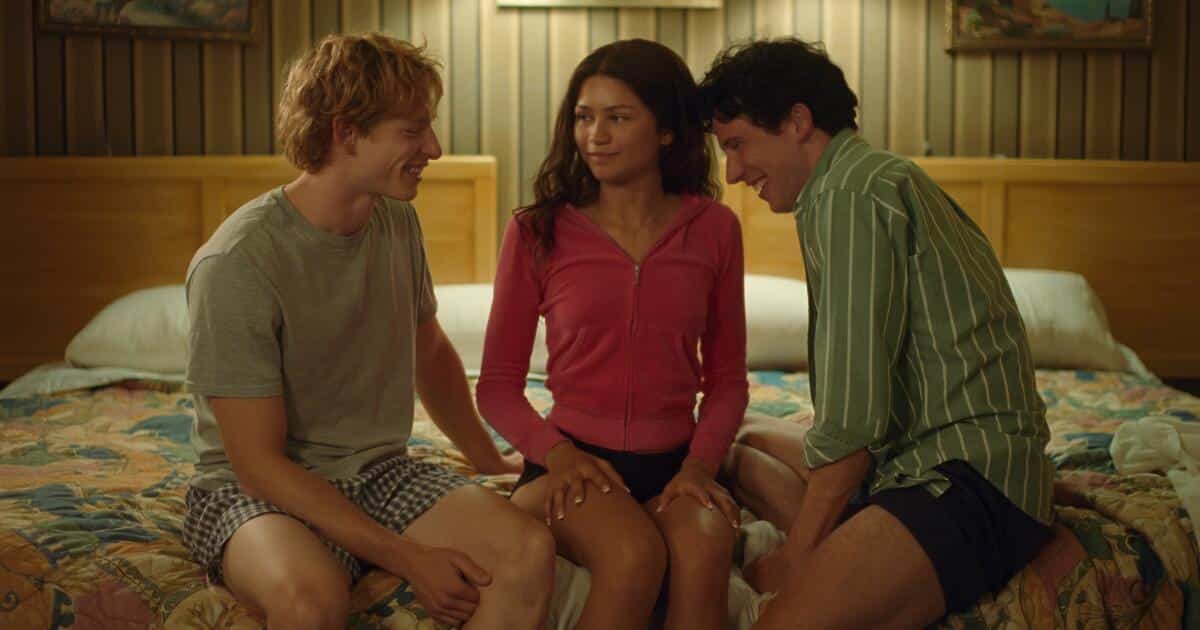
The screenplay, written by Justin Kuritzkes, alternates between a 13-year period during which the three main characters age from 18 to 31 (at least physically). Tashi is the object of perpetual rivalry between two tennis camp roommates: Patrick (played by Josh O’Connor), the wanderer who wins her over first, and Art (Mike Faist), the eager beaver who eventually marries her. However, Tashi, the superior tennis player of the trio, controls the dynamics. She thrives on the boys’ rivalry and insists that the tension enhances their tennis performance as well. The film doesn’t make us believe her or even believe that any of them truly love each other. Kuritzkes is married to filmmaker Celine Song, whose semi-autobiographical “Past Lives” also centers on a woman entangled in a love triangle, questioning her choice of partner. I won’t delve into the intricacies of anyone’s marriage, but I will say these two films would make for a provocative double feature.
Tennis is the only thing that matters. Nothing else merits discussion unless it’s veiled in tennis-related advice. Tashi, Art, and Patrick aren’t fully fleshed-out characters. We don’t care about their families, friends, or lives outside the tennis court. Even when the film briefly explores Tashi and Art’s first year at Stanford, it’s hard to believe that either of them could name a single book. These individuals aren’t fully developed, not even towards their young daughter (A.J. Lister), who is repeatedly brushed off with promises of quality time once her parents finish their tennis discussion. (“But you’re always talking about tennis,” the girl laments, a phrase she’ll likely repeat to her future therapist.) On the rare occasions when the dialogue veers away from tennis, it feels off, like a gag that Kuritzkes borrows from the infamous exchange between Han and Leia in “The Empire Strikes Back” (“I love you.” “I know.”)
The film begins in the present, with Art and Patrick facing off at the 2019 Phil’s Tire Town Challenge in New Rochelle, N.Y., a surprisingly modest setting for the intense flashbacks yet to come. But the modesty is fitting. Art, the more successful of the two, is likened to a floundering whale in need of confidence, according to the sports commentators who awkwardly foreshadow his arc in the opening scene. Art has a personal massage therapist, a fridge full of cold-pressed juices, a range of personalized rackets, and a wife who doubles as his business manager and coach. Patrick, on the other hand, is a solitary, chain-smoking has-been who scrounges for leftover bagels, sleeps in his car, and is denied when he tries to exchange an autographed racket for a motel room deposit.
We’re led to believe that we should be rooting for the underdog. But to the film’s credit, O’Connor portrays Patrick more like a crafty street-wise stray, an emaciated creature that you empathize with but wouldn’t want anywhere near your pet. Patrick doesn’t appreciate his talent nor does he respect the game; consequently, the film doesn’t respect him. As Patrick saunters through the film, invading personal spaces with his imposing presence and unapologetic habit of pilfering snacks (and dropping his pants), Guadagnino indulges in close-ups of O’Connor’s face contorting into a smug grin. Guadagnino overuses this smirk to the point of overkill, perhaps to suggest that Patrick’s charm is losing its allure. So how will this creature survive?
Conversely, the pressure of Art’s success has left him drained. Winning the woman of his dreams has left him feeling as hollow as a champagne-drained trophy.
Leisurely piano melodies underscore the mesmerizing effect Tashi has on both men. More often than not, however, “Challengers” punctuates scenes with an assertive electronic score by Trent Reznor and Atticus Ross, which is fantastic but only occasionally seems to relate to the visuals. The heavy beats work best as a metronome for the tennis spectators in the stands, their heads moving rhythmically with each volley. For a while, I was half-convinced that the background music was also playing in Art’s mind whenever his wife wasn’t lecturing him about his game.
Really, though, I think Guadagnino is just having a ball, especially when the pulsating rhythm becomes more pivotal than the dialogue. Some conversations are drowned out by the noise. Instead, they have that distorted, echoey sound of movie quotes sampled into club music, much like how George Michael’s song “Too Funky” incorporated a line from “The Graduate’s” Anne Bancroft: “Would you like me to seduce you?”
In the same vein, the visual style is so captivating that it seems like cinematographer Sayombhu Mukdeeprom was instructed to experiment with every possible technique: freeze-frames, slow motion, character fade-ins and fade-outs, extreme close-ups of sweat droplets, compelling long takes where the acting shines. The camera is above the court, beneath the court, obstructing the ball, focusing on the ball, focusing on the racket. The shot list probably resembles the Kama Sutra. The only unifying theme is extravagance.
Nevertheless, Zendaya’s performance cuts through the clamor. Her Tashi is all about length—long arms, long legs, long braid—with a small but fierce chin set in a defiant expression. If anger could be packaged like a cereal box, she’d be the cover girl. She delivers the sharpest, most biting comebacks and commands the screen like a woman in control, even when the film exploits her. Guadagnino introduces her in a glute-centric shot reminiscent of the “Athena Girl,” the iconic 1970s calendar photo of a tennis player scratching her bare butt. Of course, Tashi would never show such disrespect towards the game she reveres. Her passion for tennis and the simmering emotions it stirs is so captivating that it was only during the final game, when the film’s pace slows to a frustrating crawl, did I realize I still didn’t know how to keep score in tennis. Tashi would consider that the ultimate betrayal.
Similar posts:
- Zendaya’s Shocking Spider-Man Prophecy: From Female Lead to Tennis Pro Revealed!
- Unmissable! Year’s Top-Rated Movie Now Streaming – Find Out Where!
- Shocking! Daniel Craig Transforms into a Lonely Expat in ‘Queer’ – A Must-See!
- ‘The Fall Guy’ Bombing at Box Office, But Could Make Shocking Comeback!
- Monster High Beats Barbie! Universal’s Epic New Film Based on Mattel Dolls Shocks Fans!

My name is Alex Carter, a journalist with a deep passion for independent cinema, alternative music, and contemporary art. A University of California, Berkeley journalism graduate, I’ve honed my expertise through film reviews, artist profiles, and features on emerging cultural trends. My goal is to uncover unique stories, shine a light on underrepresented talents, and explore the impact of art on our society. Follow me on SuperBoxOffice.com for insightful analysis and captivating discoveries from the entertainment world.